Quick Start Guide
Multiple installation methods for the Zer0-Mistakes Jekyll theme - from AI wizard to manual setup.
Table of Contents
Quick Start Guide
This guide covers all installation methods for the Zer0-Mistakes Jekyll theme.
Choose Your Path
| Path | Method | Best For |
|---|---|---|
| A | AI Install Wizard | Creating a new site (recommended) |
| B | GitHub Template Repo | One-click copy of the entire repo |
| C | GitHub Codespaces | Zero-install cloud development |
| D | Fork/Clone | Personal site & theme customization |
| E | Remote Theme | GitHub Pages without copying files |
| F | Ruby Gem | Traditional Jekyll workflow |
Path A — AI Install Wizard (recommended)
Prerequisites
- Docker Desktop
- Git (optional, but recommended)
1) Full install (default)
Create a new folder and run the installer:
mkdir my-site
cd my-site
curl -fsSL https://raw.githubusercontent.com/bamr87/zer0-mistakes/main/install.sh | bash -s -- --full
A successful run ends with a summary and your next steps:
[SUCCESS] Installation completed successfully!
[INFO] Installation mode: full
[INFO] Next steps:
  1. cd my-site
  2. Review and customize _config.yml
  3. Run 'docker-compose up' or 'bundle install && bundle exec jekyll serve'
  4. Visit http://localhost:4000 to see your site
The full install lays down the complete theme (~500 files: layouts, includes, Sass, assets, Docker config). The --minimal variant writes only the handful of config files below.
Notes:
--fullis the default; it installs the full theme structure, Docker config, and development overrides.- The installer runs in “remote mode” when it’s executed via
curland downloads the theme files automatically. - The installer creates a project-local
INSTALLATION.mdinside the generated site folder.
2) Start the dev server (Docker)
From inside your generated site folder:
docker compose up # or: docker-compose up (v1 syntax)
The first run builds the image and installs gems, so it takes a few minutes. When it’s ready you’ll see Jekyll’s server line:
       Jekyll Feed: Generating feed for posts
                    done in 4.2 seconds.
 Auto-regeneration: enabled for '/site'
    Server address: http://0.0.0.0:4000
  Server running... press ctrl-c to stop.
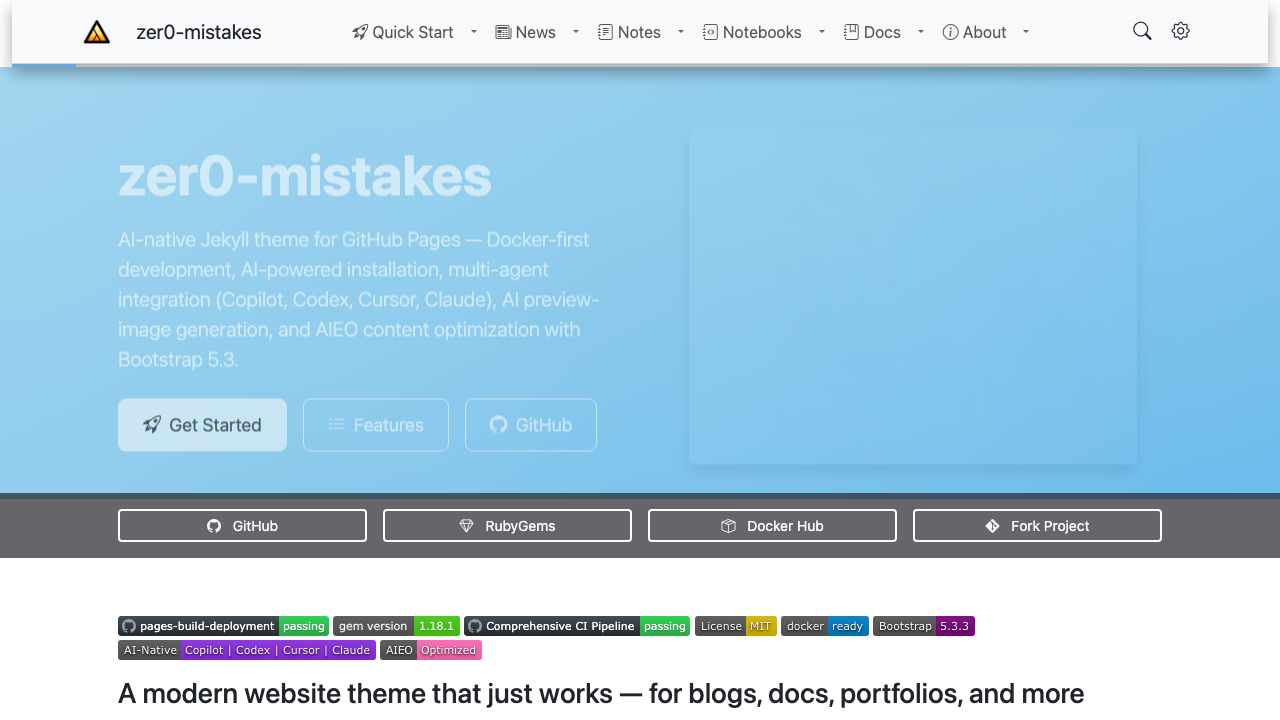
Then open http://localhost:4000 — your site is live:
Verify it worked
- The homepage renders with the top navigation bar and a “Get Started” hero.
- Editing any file under
pages/and saving live-reloads the browser. -
A quick build check (run in a second terminal) should exit cleanly:
docker compose exec -T jekyll bundle exec jekyll build \
  --config '_config.yml,_config_dev.yml'
Tip:
docker compose(v2, a space) anddocker-compose(v1, a hyphen) are interchangeable here. Use whichever your Docker install provides.
3) Minimal install (optional)
If you want a barebones starting point:
mkdir my-site-min
cd my-site-min
curl -fsSL https://raw.githubusercontent.com/bamr87/zer0-mistakes/main/install.sh | bash -s -- --minimal
You can upgrade a minimal install to full later:
curl -fsSL https://raw.githubusercontent.com/bamr87/zer0-mistakes/main/install.sh | bash -s -- --full
Path B — GitHub Template Repository
One-click to create your own copy of the entire repo.
Option 1: GitHub UI
- Go to github.com/bamr87/zer0-mistakes
- Click “Use this template” → “Create a new repository”
- Clone your new repo and start developing
Option 2: GitHub CLI
gh repo create my-site --template bamr87/zer0-mistakes --clone
cd my-site
docker-compose up
Note: You must enable “Template repository” in repo Settings → General for this to work.
Path C — GitHub Codespaces (zero-install)
Develop entirely in the cloud — no local Docker or Ruby required.
Option 1: One-click

Option 2: From the repo
- Go to github.com/bamr87/zer0-mistakes
- Click Code → Codespaces → Create codespace on main
- Wait for the environment to build (~2 min)
- Site auto-starts at port 4000
Option 3: VS Code
- Install the GitHub Codespaces extension
- Open Command Palette → Codespaces: Create New Codespace
- Select
bamr87/zer0-mistakes
Path D — Fork/Clone (personal site)
Fork into <your-username>.github.io for a GitHub Pages user site that works out of the box.
Prerequisites
- Docker Desktop
- No existing
<your-username>.github.iorepository (one free user site per GitHub account)
1) Fork the repo
- Go to bamr87/zer0-mistakes → Fork
- Set Repository name to
<your-username>.github.io - Enable Settings → Pages → Deploy from branch:
main - Your site goes live at
https://<your-username>.github.io
2) Clone and configure locally
git clone https://github.com/<your-username>/<your-username>.github.io.git
cd <your-username>.github.io
./scripts/fork-cleanup.sh   # interactive config wizard
3) Start development (Docker)
docker-compose up
This uses both configs: _config.yml,_config_dev.yml
4) Useful Docker commands
# Rebuild when dependencies change
docker-compose up --build

# Open a shell in the container
docker-compose exec jekyll bash

# Stop containers
docker-compose stop

# Remove containers + network
docker-compose down
See docs/FORKING.md for the full fork → configure → personalize workflow.
Path E — GitHub Pages Remote Theme
Use this if you want your own repo to reference the theme without copying files.
In your site repo’s _config.yml:
remote_theme: "bamr87/zer0-mistakes"
plugins:
  - jekyll-remote-theme
Notes:
- GitHub Pages has a plugin whitelist; keep custom plugins to a minimum.
- Local development via Docker is usually simpler than trying to match GitHub Pages Ruby/Jekyll versions by hand.
Path F — Ruby Gem Theme
Use this if you prefer installing the theme as a gem.
In your Gemfile:
gem "jekyll-theme-zer0"
In your _config.yml:
theme: "jekyll-theme-zer0"
Then:
bundle install
bundle exec jekyll serve --config "_config.yml,_config_dev.yml"
First Personalization Checklist
Most customization starts in _config.yml (production) and _config_dev.yml (development overrides).
1) Update your site identity (_config.yml)
Common fields to change:
title,subtitle,descriptionurlandbaseurlauthor.*/name/emaillogo/teaser/og_image
Important:
_config.ymlchanges are not hot-reloaded by Jekyll; restart your dev server after edits.
2) Disable or replace analytics (_config.yml)
This repo ships with analytics settings (Google Analytics + PostHog). For your own site:
- set
google_analytics: null(or your own ID) - for PostHog, either set
posthog.enabled: falseor replaceposthog.api_key+posthog.api_host
In development, analytics are already disabled in _config_dev.yml.
3) Customize navigation
Navigation data lives under:
_data/navigation/
If you want to change menus/sidebars, start there, then check:
_includes/navigation/
4) Add/replace content
Typical content locations:
index.html/index.md(homepage)pages/(site pages)pages/_posts/(blog posts, if you use posts)pages/_docs/(published end-user documentation)
Troubleshooting
Port already in use
If 4000 is taken, change the host port mapping in docker-compose.yml:
ports:
  - "4001:4000"
Apple Silicon (M-series Macs)
This repo’s Docker config uses platform: linux/amd64 for compatibility. If Docker warns, it’s usually safe to proceed.
Theme not found / remote theme issues
For local Docker development, _config_dev.yml disables remote_theme to avoid requiring GitHub theme fetches.
Config changes don’t show up
_config.ymlchanges require restarting the Jekyll server.- Try:
docker-compose down
docker-compose up
Next Steps
- Theme Guide — Complete customization guide
- Front Matter — Configure page metadata
- Features — Enable Mermaid diagrams, comments, analytics
- Deployment — Publish your site
Technical Reference
For contributor-level details (installer architecture, profile system, deploy target modules):
See also
- [[Getting Started]]
- [[Installation]]
- [[Docker]]
- [[Customization]]